GAP EFFECT ON AERODYNAMIC PERFORMANCE OF A FLAT PLATE WITH FORE AND AFT EMBEDDED ROTATING CYLINDERS
Keywords:
boundary layer separation, computational fluid dynamics, gap variation, Magnus effect, unmanned aerial vehiclesAbstract
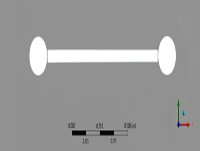
Boundary layer separation significantly affects aerodynamic performance of airfoils, turbine blades and flat plates, which reduces lift at high angles of attack and limits the efficiency in applications such as unmanned aerial vehicles (UAVs). A promising approach to delay the separation and enhance lift is the use of rotating cylinder near the surface, which leverages Magnus effect to inject momentum into the boundary layer. This study investigates the aerodynamic performance of a flat plate embedded with fore and aft rotating cylinder (CyFlaP), with particular emphasis on the influence of the gap size between the cylinders and the plate. The main objective is to identify the optimal gap configuration for maximizing lift coefficient (CL) while ensuring flow stability across different Reynolds number regimes. Two-dimensional computational fluid dynamics (CFD) simulations were conducted in ANSYS Fluent, employing the SST k – ω turbulence model. For the analysis, the gap variation is from 1 mm to 10 mm while the inflow velocities ranging from 5 m/s to 30 m/s as these ranges capture the practical operating conditions and allow evaluation of their influence on the aerodynamic performance. A structured mesh with validated grid independence was used and the transient solver settings captured unsteady vortex dynamics around the rotating cylinders and flat plate. Results indicate that narrow gaps of 1 mm to 2 mm achieved the highest lift, with coefficients exceeding 3.7 at 20 degrees angle of attack for 5 m/s, corresponding up to 9% improvement over wider gaps. Nevertheless, this advantage diminished with increasing velocity, where wider gaps consistently underperformed and all configurations converged to CL less than 1.4 at 25 m/s to 30 m/s. On the whole, the study concludes that gap tuning is most effective at low to moderate Reynolds numbers, with 1 mm identified as optimal and 2 mm to 3 mm offering a practical compromise for UAV applications. This effectiveness arises because smaller gaps enhance the momentum injection into the boundary layer, strengthening circulation around the plate and delaying flow separation while slightly larger gaps maintain lift enhancement without excessive viscous losses.
Downloads
Downloads
Published
How to Cite
Issue
Section
License
Copyright (c) 2025 Journal of Aerospace Society Malaysia

This work is licensed under a Creative Commons Attribution-NonCommercial 4.0 International License.

